Introduction to psychology
Below material was captured as notes, while I was studying Introduction to psychology out of curiosity, a course made available by Yale.
Brain
Astonishing hypothesis
It was given by Francis Crick, who was one of the discoverer of molecular structure of DNA. He said that
a person’s mental activities are entirely due to the behaviour of nerve cells, glial cells, and the atoms, ions, and molecules that make them up and influence them.
This puts a question in front of us, do we really have control on ourselves or are we just a physical machine who is controlled by some undiscovered power?
Dualism
Descartes said humans are not machine and they have control over themselves, their actions and emotions unlike animal. Humans are a part of dualism which consist of a material body and an immaterial mind. He gave two arguments why we are not machine and a part of dualism:
- Humans can choose what to say, how to react, etc to different situations and questions.
- The soul is entirely distinct from the body. (He considered brain to be immaterial part of our existence)
But he failed to explain, how humans learn to talk? What makes someone attractive? How is soul connected with material body.
Neurons
The basic unit of brain is a neuron, basic building block. It is made up of three main parts:
- Dendrites: Neurons get signals from other neuron here. It decides whether to fire a neuron or not. It depends on some threshold value.
- Axon: Firing from dendrites happen here. It can be in feet.
- Axon terminals: It helps connecting with other neurons.
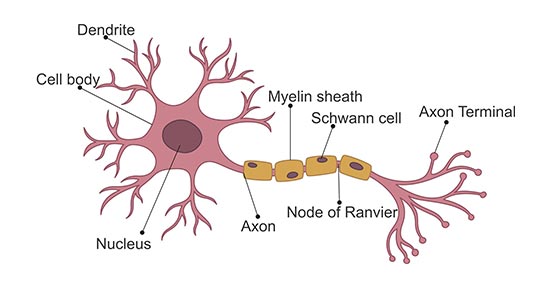
There are three types of neurons:
- Sensory neurons (helps in vision, hearing, etc)
- Motor neurons (helps picking hand up, walking, etc)
- Inter neurons (helps in thinking, connect sensation and action, etc)
Neurons are like gun, they fire or they fail to fire (failing to fire can cause some neurological probelm). But then how do we measure the intensity of some external change? It is decided by the number of neurons firing and frequency of firing.
There is a very small gap between axon and dendrite of next neuron called synapse. A chemical is released between them called neurotransmitter. Humans can change the amount of neurotransmitter in couple of ways to get different results:
- Antagonist: External chemical which blocks motor neurons. Alcohol also inhibits the inhibitory neurons which are predominantly present in PFC which generally tells us what not to do like not killing anyone, keeping pants on, etc.
- Agonist: Chemicals which increase the amount of neurotransmitter (hightened sensation, etc).
Parts of brain
Although it seems we require brain for everything, there are few things which doesn’t require any brain.
- New born sucking
- Withdrawal from pain
- Vomiting
The main parts of brain are:
- Medulla: It is used for heart rate, respiration, etc.
- Cerebellum: Body balance and muscular coordination, etc.
- Hypothalamus: Feeding hunger, thirst, etc.
- Cortex: Outer layer covering brain about 2 ft. in area.
- Cortex contains frontal lobe, temporal lobe, etc.
- The two hemisphere of the brain are connected by corpus callosum.
Our brain contains topographical arrangement similar to our body. If two body parts are near, their corresponding brain part would also be very close to each other.
Apraxia: Brain cant provide the correct set of movement to different body part like waving, walking, etc.
Agnosia: When brain loses the ability to recognize faces, objects, places, etc.
Aphasia: Ability to not understand and produce language.
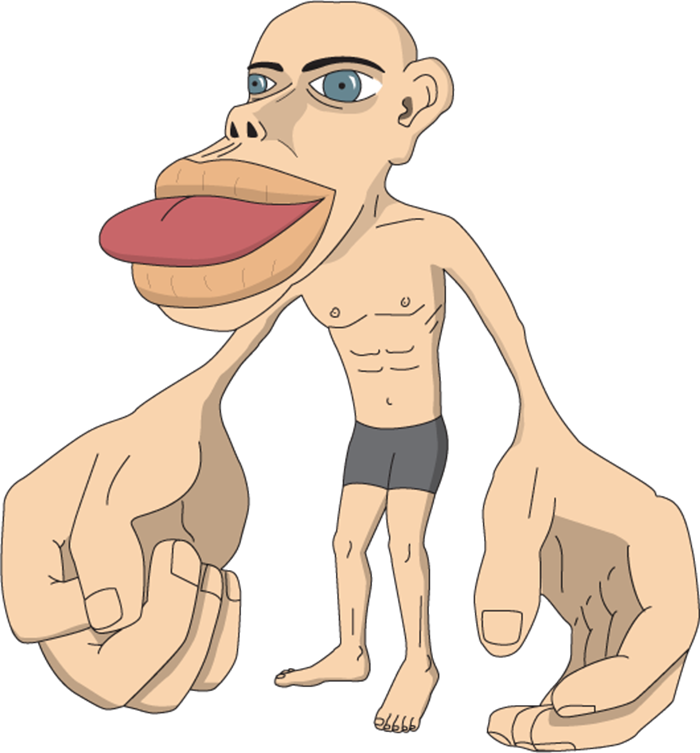
If we map every body part by the part of the brain it acquires, we get a sensory homunculus mode, which is weird to look at but tells a lot about human brain.